53.8% email click-through rate before a single product shipped
Before spending anything on ads, I needed to know whether the audience I was building for actually existed. So I built a Klaviyo welcome email flow with dark-themed templates matching the brand aesthetic, copy written in the brand's actual voice instead of the corporate marketing-speak that makes people's eyes glaze over.
The result: a 53.8% click-through rate. That's 14 unique clicks from 26 double-opt-in subscribers, against Klaviyo's 2026 automotive flow benchmark of 5.45% (Klaviyo 2026 Benchmarks, published February 24, 2026, based on 183,000+ customers). Roughly 10x the industry average and 5x even the all-industry top 10% threshold of 10.48%.
Yes, 26 subscribers is a small list. I'm not pretending otherwise. But these were double-opt-in. Every one of them signed up, confirmed, and chose to be there. And CTR measures real human action, not vanity metrics. Unlike open rates, it isn't inflated by Apple Mail Privacy Protection. More than half of a self-selected, confirmed audience clicked through on a pre-launch email for a brand with zero products live. That's signal.
Data pulled from Klaviyo API. Benchmark: Klaviyo 2026 Automotive Flow Average (published Feb 24, 2026, 183,000+ customers).
I messaged a competitor about a custom order. They never responded.
Osaka Nights started the way more brands probably should: with a frustrated customer. I found Five Dimes on Etsy and messaged them about a custom tsurikawa for my car. No response. Their website had custom options marked "sold out" indefinitely. I searched everywhere else. Nothing but basic colours and zero customization.
Quick context: a tsurikawa is a train handle grip from Japanese subways. Bōsōzoku, the outlaw biker gangs of 1970s and 80s Japan, started ripping them from trains and hanging them off their modified cars as a symbol of rebellion. In drifting culture, they swing wildly through every turn. They went from subway hardware to street legend.
I wanted one for my car. Nobody could make what I wanted. So I decided to figure it out myself.
Some people find their thing at 18. I found mine at 28, behind the wheel for the first time, somewhere between midnight and dawn. I grew up in Saudi Arabia, where women weren't legally allowed to drive. When I finally got my license in Canada, driving became the first real freedom I'd ever felt. That's not marketing copy. That's why the brand exists.
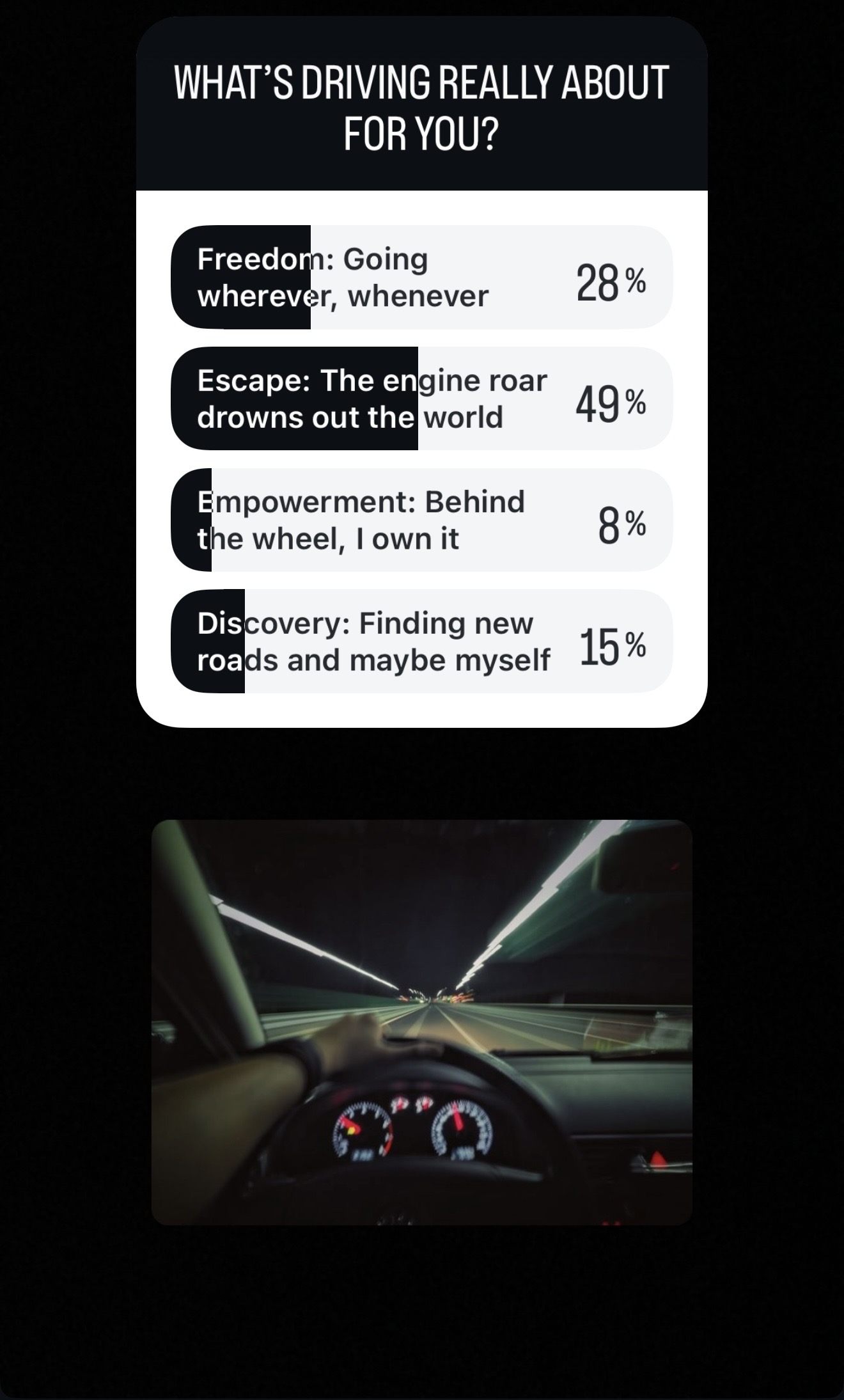
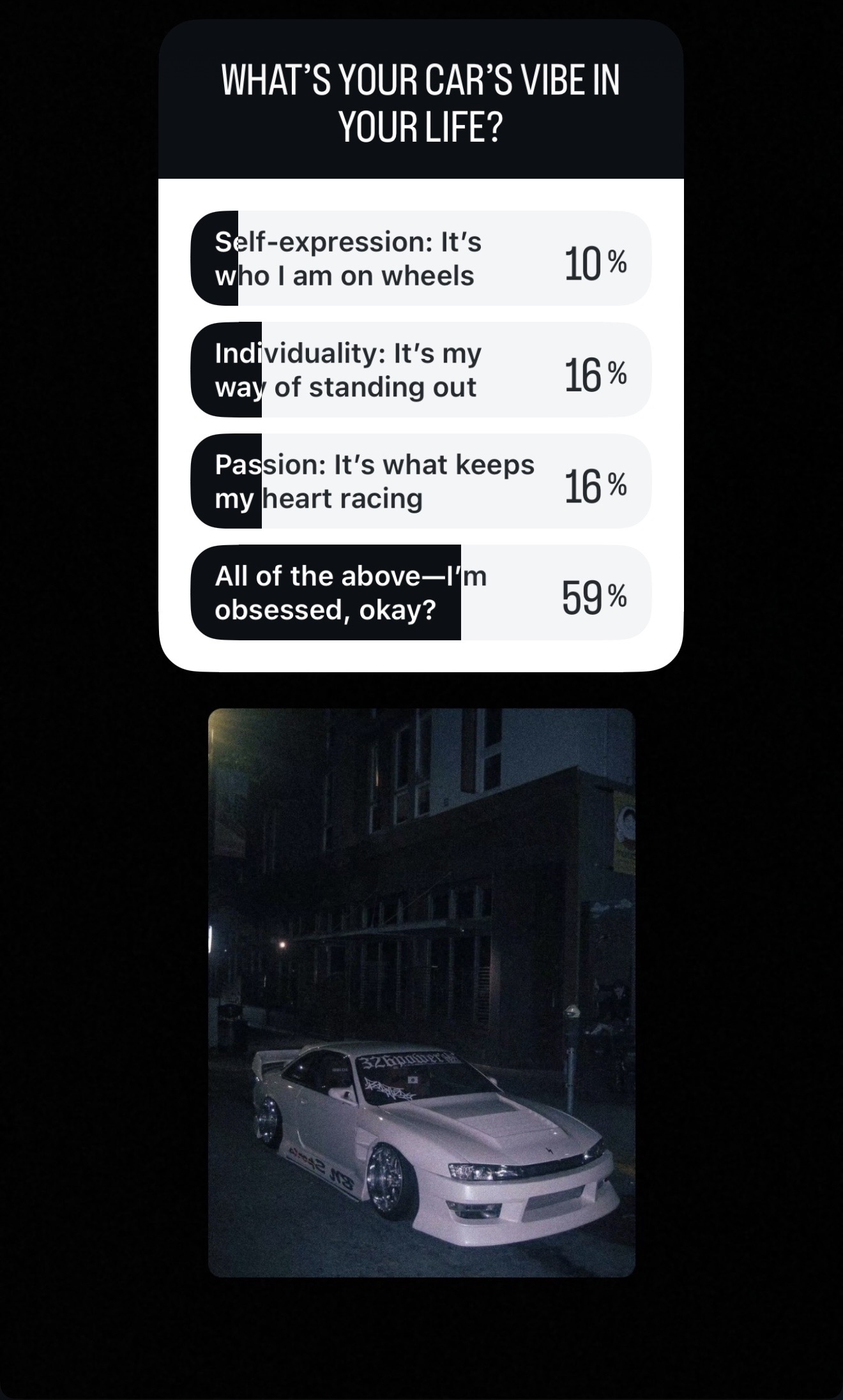
66% of the audience said their car has saved them. That's not a market segment. That's a community.
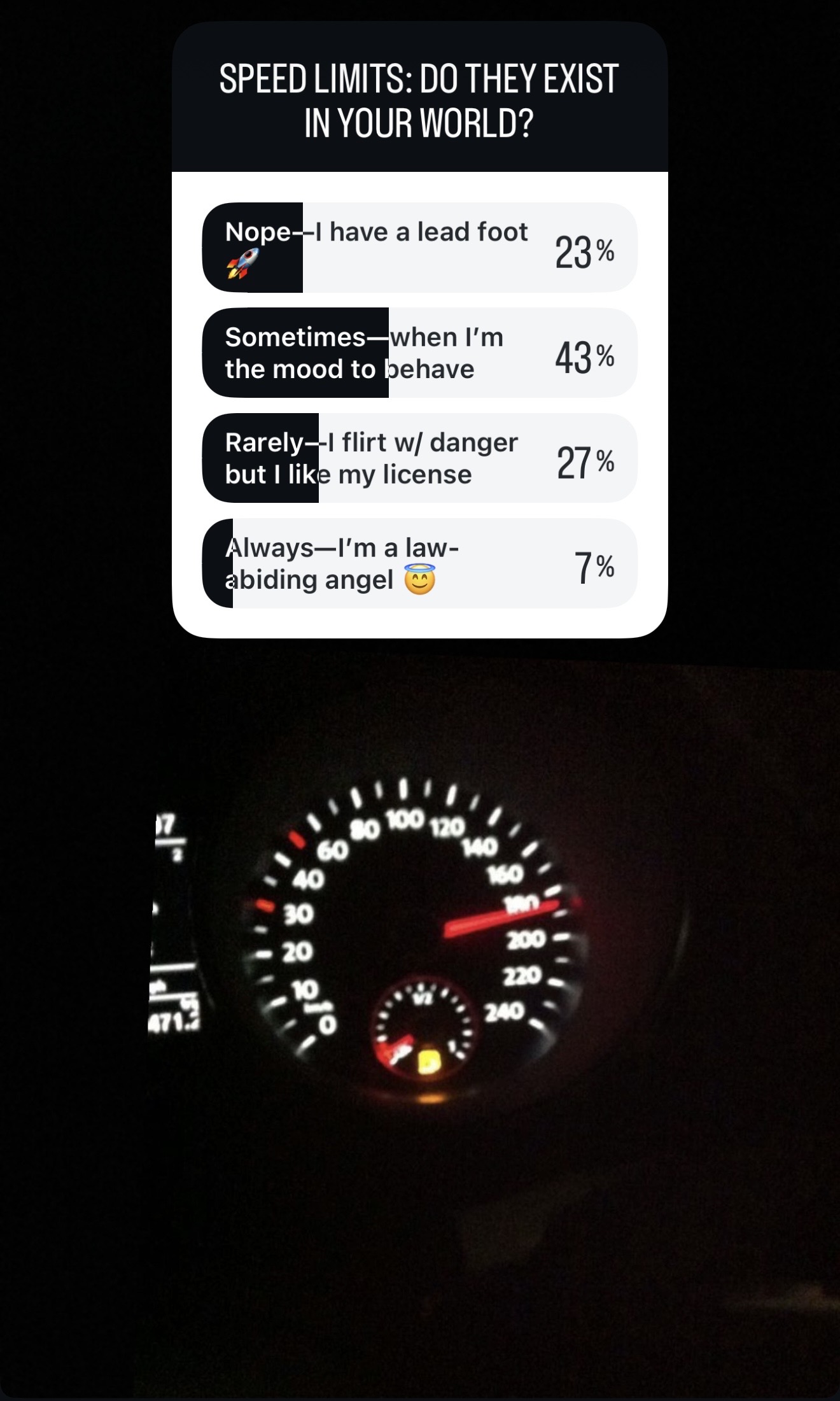
I ran Instagram polls to test whether this was a real market or just my own obsession. The results: 66% said their car has saved them. 49% described driving as escape. 59% said they're obsessed with every aspect of their car, not just performance. And 59% said they don't relate to rebellion or defiance at all. They just love cars.
That last number changed the entire brand strategy. The tsurikawa itself has roots in rebellion (JDM Tsurikawa's site literally calls it "a symbol of freedom and disrespect of authority"), and the product's origin story is countercultural. But the actual audience? They don't relate to rebellion or defiance. They relate to cars as therapy, escape, and identity. That gap between the product's history and the audience's reality became the foundation for everything Osaka Nights is built on.
I ran Semrush competitive analysis on three established brands (HardTuned, Happy Endings, and JDM Tsurikawa), tracking their website traffic, ad spend, and content activity weekly through EyeOn. I also did manual competitive research on two more brands, Five Dimes and Over Limitz, through their Etsy stores, websites, and Instagram. Some had cool products but no brand story. Others had the aesthetic but nothing custom. The market had products. It didn't have a brand that actually understood its audience.
Data from Semrush Market Explorer. TAM = total category traffic. SAM = direct competitor audience overlap in JDM accessories niche.
The Instagram numbers backed this up. At just 195 followers, my top Reel hit 3,666 views. That's 18.8x the follower count, against a Socialinsider benchmark of ~20% view rate for accounts in the 1K to 5K tier. The top post pulled 259 likes and 31 comments, a 132% like-to-follower ratio against the 8 to 10% benchmark for sub-5K accounts (PopularPays, 2025). Comment rate hit 15.9%, which is 10 to 15x the benchmark for accounts five to twenty-five times this size. Posts average 120+ likes with zero ad spend. The account has since grown to 233 followers with engagement holding steady.
A note on the numbers: small accounts naturally get inflated engagement rates because Instagram's algorithm tests new content broadly. I'm not claiming these ratios will hold at 10K followers. But even accounting for the small-account boost, the engagement is consistently 10 to 15x benchmarks for accounts in the same tier, and the content is generating saves, shares, and DMs, which are the metrics that matter for organic reach. People weren't just watching. They were engaging, commenting, sending the content to friends. That's product-market signal with zero ad spend.
My first LED sample was the same panel my competitor sells. I kept going.
May 2024, I ordered my first LED car window display sample from Alibaba. When it arrived, I realized HardTuned was selling the exact same panel. Looks decent at night, practically invisible in daylight. I researched further and found Over Limitz uses a display that only lets customers paste their text once. One and done.
So I sourced a hard-shell LED display: visible during the day, unmissable at night. Bluetooth-controlled so customers can swap between their Instagram handle, animations, or custom text from their phone anytime. Three power options: car charger for daily driving, USB adapter for shows, and a portable power bank so the display stays on even when the car's off at meets.
Over the following months I managed the full international supply chain across multiple Alibaba suppliers: LED screens, custom-printed boxes, mounting hardware. When my primary supplier contact left the company in September 2025, I rebuilt the relationship with her replacement from scratch. When a replacement screen arrived disassembled, voiding the warranty, I navigated the dispute process and secured a refund anyway.
I built the tsurikawas (the product that started all of this) from Smooth-On TASK 3 urethane resin. Impact-resistant, scuff-resistant paint that won't peel, with full colour customization in any shade a customer wants. Five adjustable strap lengths so the handle sits at the right height for each car's interior. Authentic Nishijin-ori brocade from Kyoto — luxury woven silk in five lengths for a stance-specific fit.
Apparel rounds out the catalog: AS Colour premium blanks with metallic embroidery using French Sajou Fil Au Chinois threads — the same threads used in haute couture.
A 29-page brand identity system built on data, not gut feeling
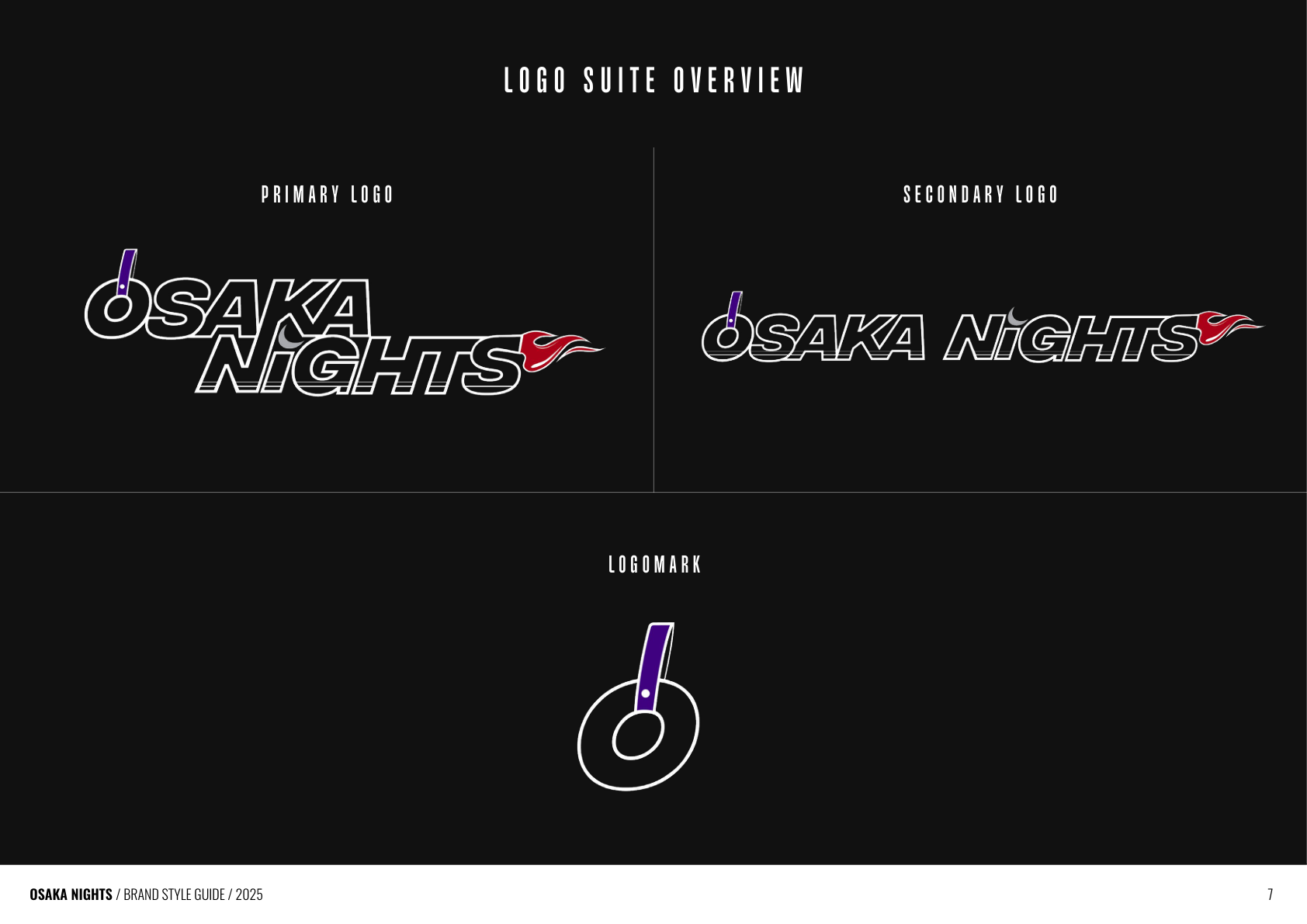
Once product direction was locked, I hired Kimmy Tran (kimmytrandesigns.com) for brand strategy and creative direction. Together we built a 29-page style guide covering logo architecture, colour psychology, typography hierarchy, and brand personality. The logo integrates a tsurikawa into the "O," a crescent moon above the "i" for the nighttime aesthetic, and a flame on the "S" for speed. Every colour maps to JDM culture. Midnight Purple is a direct nod to the legendary R34 Skyline paint.
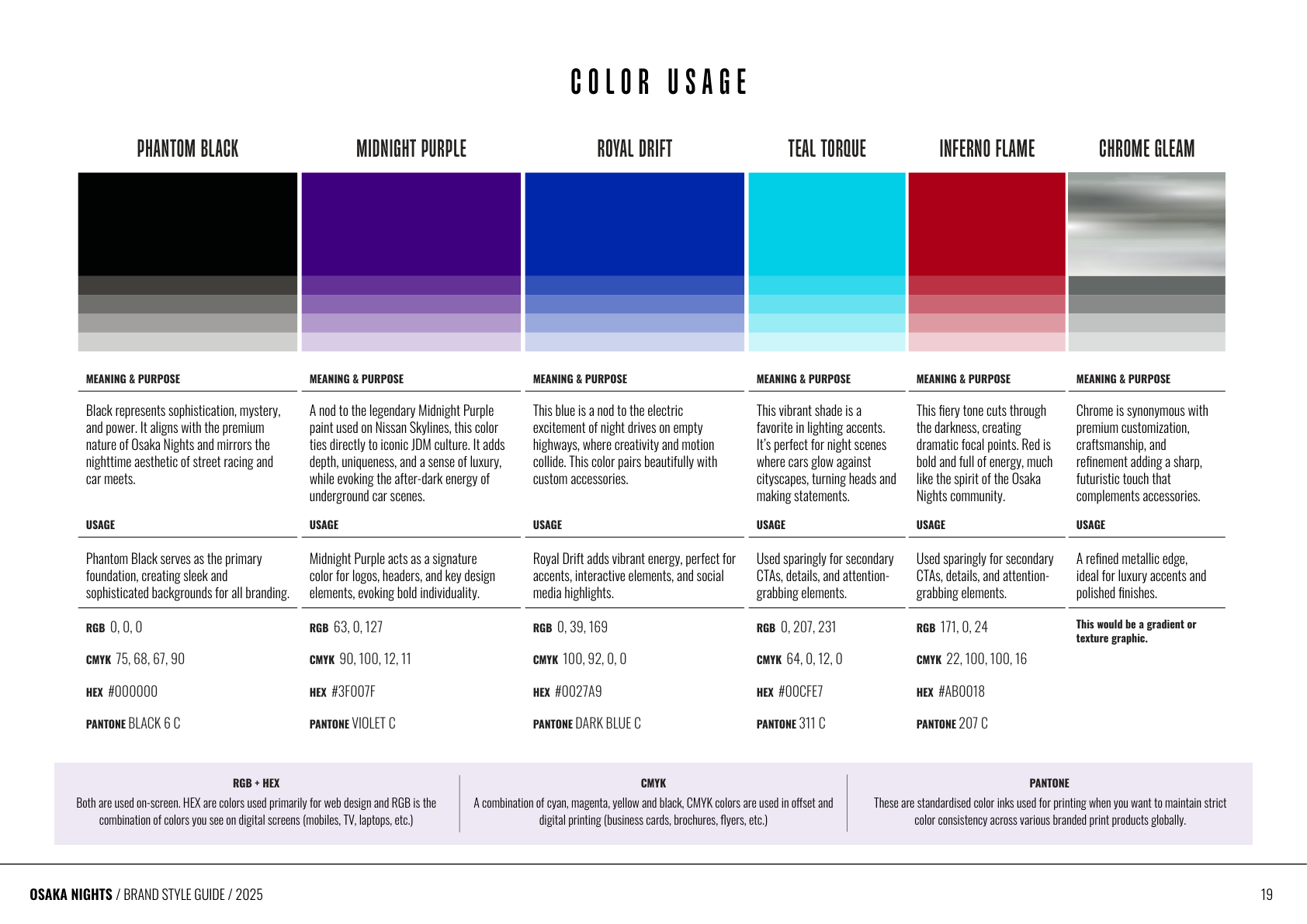
The brand voice took over a year to develop across 100+ iterations. I directed Claude as my writing team, pushing back each time the output sounded polished, corporate, or safe instead of authentic.
What I built is a modular voice system with five distinct content archetypes, each tuned for a different type of post. Think of them like presets on an equalizer: same brand, different frequencies depending on context. Savage Product for promotional content (playful competitor roasts and scroll-stopping hooks capped at 19 words). In The Trenches for raw founder moments that show the reality of building something from scratch. Built Different for punchy, confidence-forward declarations. Unhinged But Healed for the dark humour that resonates with the therapeutic car culture audience. Chaos With A Plan for launch energy and high-stakes moments.
Ten structural rules govern the entire system: night aesthetic in every post (brand DNA), show behaviour don't explain feelings, no assumptions about audience's lives, lurker protection so content stays safe when screenshots travel, "still building" language always, no fabrication, no therapy-speak, meme potential as a quality bar, and a pre-publish checklist that catches drift before it goes live.
A hiring manager might reasonably ask: why does any of this matter? Because brand voice is the difference between content people scroll past and content that stops them. This system is how a 233-follower account consistently outperforms accounts 100x its size on engagement. That's not luck. It's a deliberate content architecture.
The Shopify build: one person operating like a small agency
The Shopify storefront is a pre-launch landing page built through multiple development phases: custom CSS for a dark theme with purple gradient overlays, Liquid conditional logic for a pre-launch toggle system, critical CSS fixes for Safari mobile rendering, and self-hosted fonts to resolve browser privacy warnings.
I also configured the product customization experience using Customily: a live preview where customers type their text, pick a gradient colour, and see it rendered on the LED display in real time. Instagram and TikTok logos change colour to match the selected gradient.
I used AI tools as my development team. I directed every creative and strategic decision, tested every output, and rejected anything that didn't meet the standard. The AI wrote the code. I directed the vision, evaluated every result, and made every call on what shipped. It's a workflow that gives one person the output of a small agency, and it's a skill set I'd bring to any team.
I also completed the Google Analytics 4 certification (all four modules) and the Google Ads Search certification. The certifications gave me the analytical foundation. The implementation is part of the launch sprint alongside the Klaviyo-GA4 integration and purchase event tracking.
See the full desktop and responsive mobile walkthrough in the hero section above.
The results, and what they prove
| Metric | Result | Context |
|---|---|---|
| Email CTR (welcome flow) | 53.8% | 14/26 double-opt-in; ~10x Klaviyo automotive flow avg (5.45%) |
| Top Reel views | 3,666 | 18.8x follower count at 195 followers; benchmark ~20% for 1K to 5K |
| Like-to-follower ratio | 132% | 259 likes at 195 followers; benchmark 8 to 10% (PopularPays 2025) |
| Comment rate | 15.9% | 10 to 15x benchmark for accounts 5 to 25x larger |
| Post engagement avg | 120+ likes | $0 ad spend; now at 233 followers |
| Competitive analysis | 5 brands | 3 via Semrush EyeOn, 2 manual research |
| Brand identity | 29 pages | Complete system by Kimmy Tran Designs |
| Voice architecture | 5 archetypes | 10 rules + pre-publish checklist |
| Certifications | GA4 + Ads | Foundation for launch sprint |
What I'd do differently, and what this transfers to
I'd set up the analytics infrastructure from month one instead of month ten. I'd scope the Shopify customization more tightly instead of iterating across multiple sessions. And I'd consolidate the brand voice documents into a single canonical reference earlier. I ended up with three overlapping documents that needed reconciling.
Here's what this project proves: I can take a brand from concept to launch-ready. Market research through real audience polling and competitive data. Competitive analysis across five established brands using Semrush and manual research. Full visual identity development with a professional designer. International supply chain management across multiple Alibaba suppliers. E-commerce development on Shopify with custom Liquid/CSS. Email marketing that outperforms industry benchmarks by 10x. A content voice system that generates 132% like-to-follower ratios from under 200 followers. AI-directed execution. Solo, on a budget, with real money on the line.
The frameworks I built for Osaka Nights (audience validation before product investment, voice systems that scale, email flows that convert, content architecture that outperforms accounts 100x its size) transfer directly to any e-commerce brand at any stage. I studied psychology, decision-making, and behaviour under pressure at Western University. Then I built a brand that speaks to a community I actually belong to.
That's the difference between someone who follows a playbook and someone who writes one.