I Shut It Down
In March 2026, I permanently deleted a personal Instagram account I'd spent over five years building. Over 2.8K followers. 130+ posts. A community I thought was paying attention.
I didn't lose it. I shut it down on purpose. I'd spent months tracking who was actually engaging, and the data showed me exactly what that audience wanted. It wasn't me. It was the car.
This is how I figured that out.
When the Numbers Stopped Adding Up
In June 2024, I posted a reel that changed how I thought about this account. I call it the 101-comment reel. An audio mashup I edited myself: a melancholic intro building to a triumphant beat drop, synced to a personal narrative arc. Things I'd been through, things I'd overcome. And it generated 101 comments, the highest of any post on the account. People didn't just drop emojis. They wrote paragraphs. Their own stories, their own milestones, their own turning points. When your audience writes back with their own experience, that's not just engagement. That's connection.
That was the first time I realized the content that actually mattered had nothing to do with what I looked like standing next to a car.
Then the WRX was gone. In August 2025, I pre-launched Osaka Nights, a JDM automotive lifestyle brand, and expected a significant chunk of my followers to come along. Fewer than 100 did. I posted brand content for months, watched the engagement drop, and eventually went quiet because the account was draining me.
One influencer with over 3 million followers posted a reel about this exact phenomenon: you start building something, and the people who were supposed to support you go silent. It wasn't just me. It's a pattern creators recognize.
When I finally came back in December 2025, I spent weeks editing what I think of as the comeback reel. It went back to what had worked before. Same energy. Same vulnerability. Same person behind the screen.
Under 2K views. 84 likes. 26 comments. Zero new follows. 60.8% skip rate. 69.6% of views came from my own followers, and they still barely engaged.
The 101-comment reel in June 2024. Eighteen months later, the comeback reel on the same account got a fraction of the response. Something fundamental had changed. Not the content. The audience.
Same Person. Fraction of the Response.
The comparison that made the pattern undeniable wasn't between two random reels. It was between two that asked the same thing of my audience: connect with something real.
June 2024: The 101-comment reel. A personal narrative arc reel. 3.4K views. 101 comments. People writing paragraphs about their own turning points. The WRX was still in my life, the account was active, and the audience showed up.
December 2025: The comeback reel. Same kind of content. Same vulnerability. Same creator. Under 2K views. 84 likes. 26 comments. Zero follows. 60.8% skip rate. 69.6% of the views came from my own followers, and even they barely engaged. It still didn't land.
Between those two posts, the WRX was gone. I'd pre-launched a brand, gone quiet for months, and come back expecting at least some of my audience to still be there. They weren't. Not for this.
Over 2.8K Followers and One Wrong Assumption
I created this account on August 23, 2020. It started as a lifestyle page. Tattoo reveals, cat content, modeling, whatever felt like mine at the time. Then came the cars. A Jeep first, then a Subaru WRX, then the whole car community. I found a niche. A reason people followed. And for a while, that was enough.
In five years, the account grew to over 2.8K followers and 130+ posts spanning lifestyle, automotive, personal content, and everything in between. It was never a big account. But it was mine, and I assumed the people who followed were paying attention.
That assumption was the problem.
20K Views and My Followers Were Barely in the Room
In January 2026, while the comeback reel was flatlined, I posted the car-season collab: a 15-second automotive reel. A slow, atmospheric opening builds to a bass drop that kicks into a fast-paced sequence of car meets and drifting footage. The color shifts from dark and muted to bright and saturated at the exact moment of the drop. But the real reason it took off wasn't just the editing. It was relatable. "Four months" and a November timestamp is something every Canadian car enthusiast understands: winter storage is ending, car season is coming. I collaborated with two accounts in the community, one with 39.8K followers and one with 10.7K.
20K+ views on an account with over 2.8K followers. A 7x view-to-follower ratio. 87% of views came from people who didn't follow me. 18 new follows. 85 shares, 17 reposts, 16 saves. 52.8% skip rate, meaning 47% of viewers stayed past the 3-second mark. Average watch time: 7 seconds out of 15.
But here's what the data actually showed: I cross-referenced the liker list against my follower list. Out of 543 people who liked the car-season collab, only 73 were my actual followers. That's 13.4%. The other 86.6% were strangers who found it through the collabs and the algorithm. My followers didn't show up for the car content either. They'd checked out entirely.
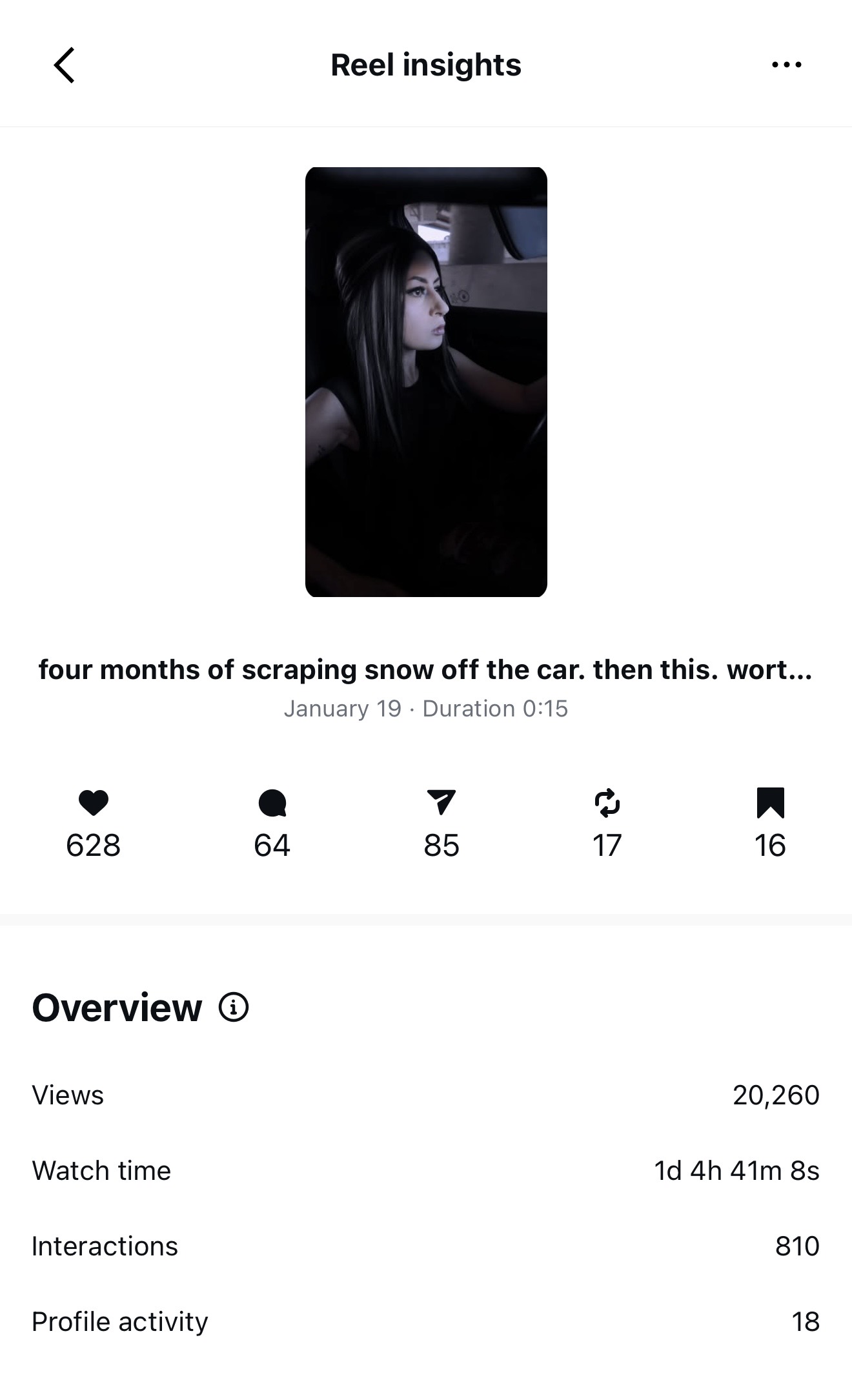
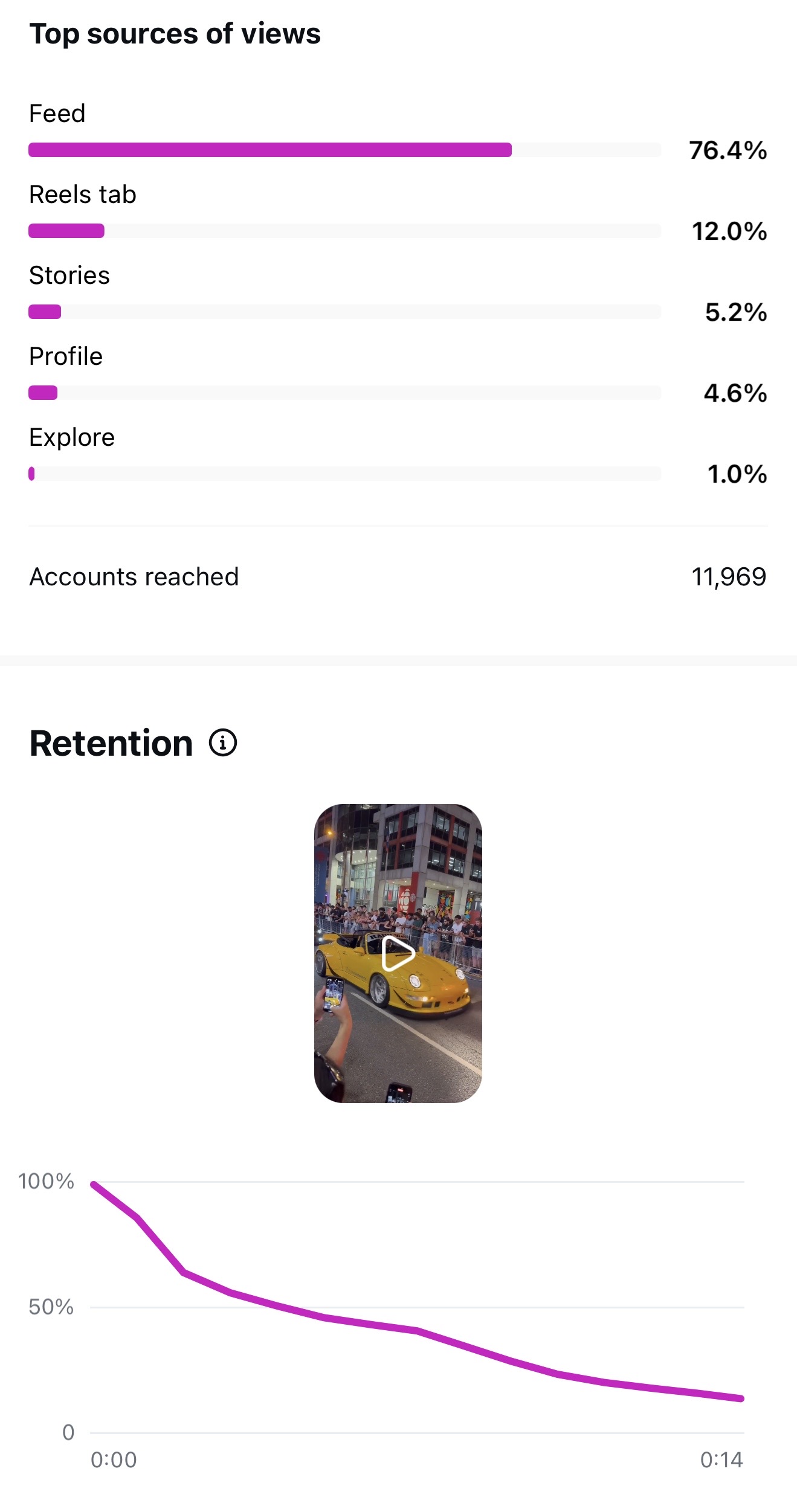
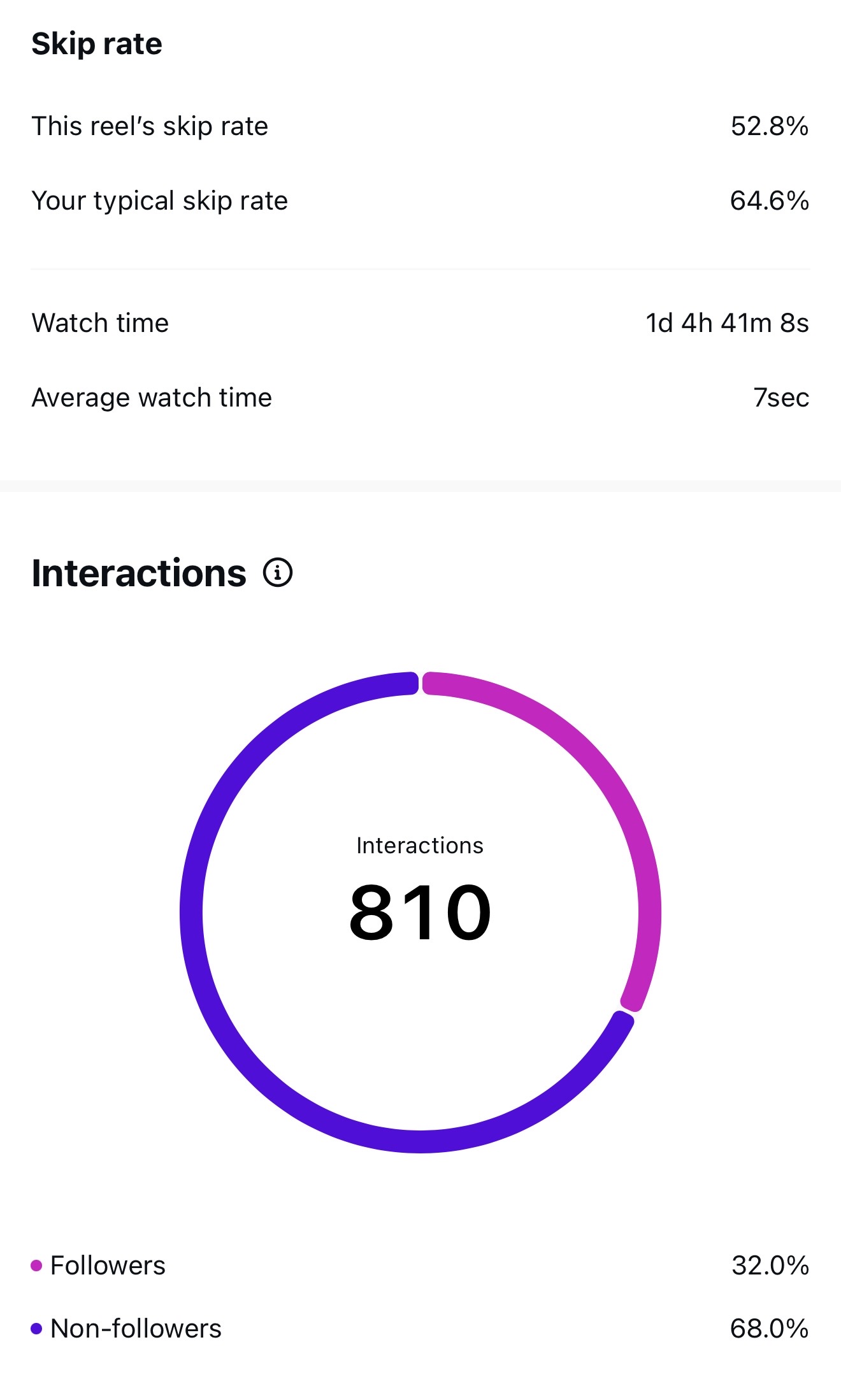
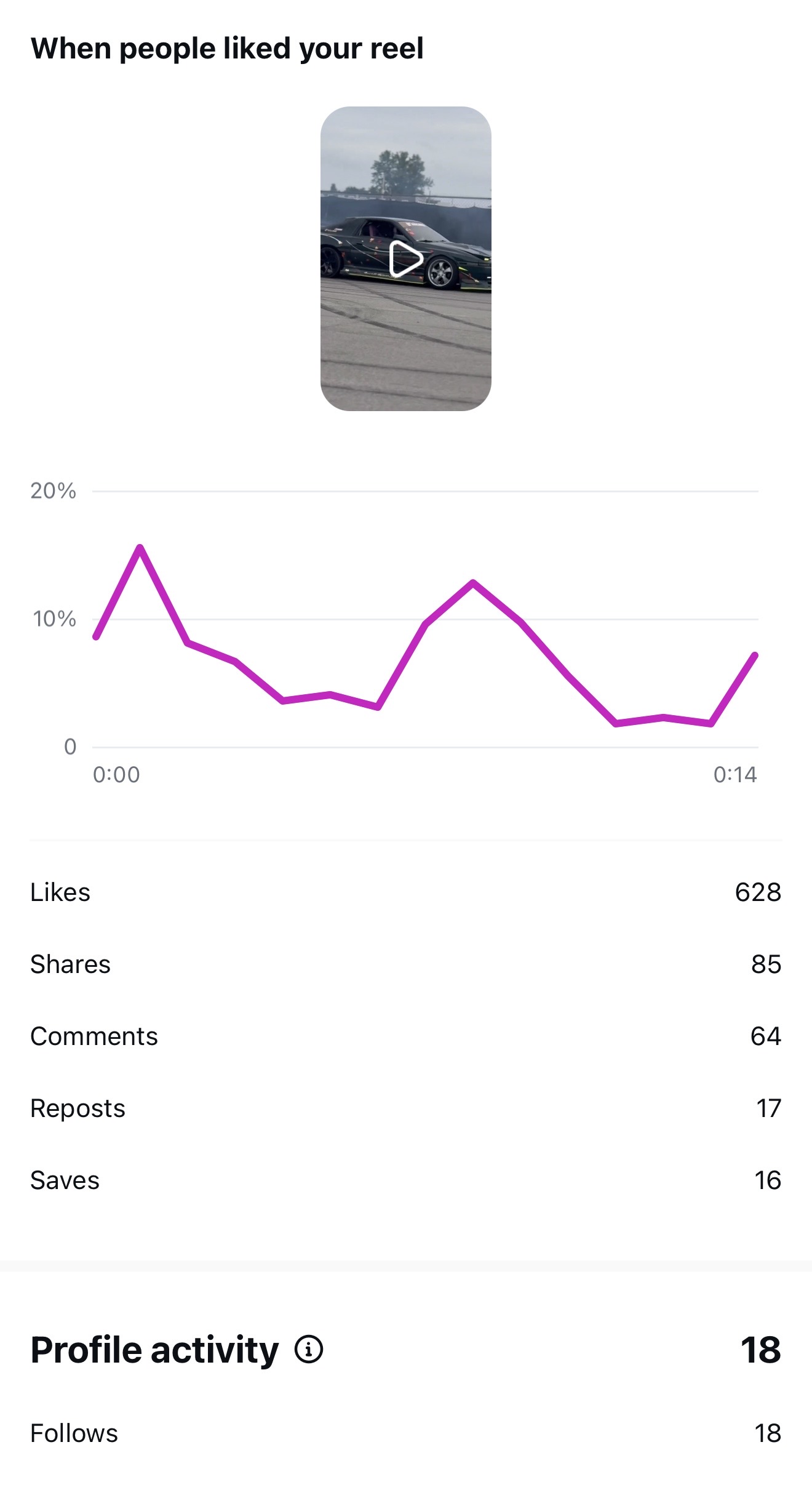
"four months of scraping snow off the car. then this. worth it."
Self-filmed, self-edited. 20,260 views. 87% non-followers.
So I Built a Tracking System
The tracking didn't start as a clean analytical project. It started because I was frustrated. I'd posted brand content for months after pre-launching Osaka Nights, watched the engagement tank, and the people who were supposed to care barely showed up. I thought at least 1,000 of my 2.8K followers would follow the brand. Fewer than 100 did. They were still watching. They just stopped engaging.
I started watching who viewed every story but never liked a post. I started testing: if I posted something they couldn't ignore, would they come back? I posted content I knew would pull a specific type of viewer back. And it worked. People who hadn't engaged in months suddenly showed up. That told me exactly what they were there for. It wasn't the brand. It wasn't the personal growth. It was what I looked like.
Then I posted what I call the driven reel. Eight seconds. Me driving. One text overlay. Post-hardcore audio. The visual was casual, the text was heavy, and the audio was intense. That contrast between what you see and what you read is what stops people mid-scroll. But the real reason it worked was simpler: what I wrote was relatable. 3.5K views. 66% from non-followers, and they watched all 8 seconds on average. 37% skip rate, the lowest I recorded. 224 likes, 28 comments, 10 reposts. 41 profile visits. Not a single new follow.
I shared the analytics publicly in a story: my non-followers were outperforming my actual followers on the content that had substance. The people who hadn't engaged in months, I could see exactly who they were and when they'd gone quiet. I wasn't guessing anymore.
Eventually I channeled that frustration into something structured.
Hypothesis: The majority of my followers had stopped engaging, and the ones still showing up weren't the audience I was building for.
What I collected: Chrome DevTools HAR captures of follower and following lists across multiple dates. Instagram's official data export (January 3, 2026). Liker lists scraped for over 30 individual posts using Chrome DevTools HAR captures and third-party tools. Instagram Insights screenshots for every reel with available analytics.
What I built: A tracking system. Every follower mapped against every post I could get liker data for. Did they like this post? When did they first show up? When did they stop? 2,730 followers tracked across 20 posts.
What it showed: I said it in the account's final story before I shut it down: "81% of this account never liked a single one of the 35 posts i actually tracked. not one."
That number came from this system. I wasn't looking at one post. I was looking at patterns across dozens. The pattern was clear: this audience wasn't just quiet on one reel. They were gone.
The Insights data backed it up from another angle. The text-loop reel hit over 22K views, but 87% of those came from non-followers. The car-season collab pulled 20K views, and when I cross-referenced the liker list, only 13% were my actual followers. My audience wasn't engaging with anything. Not the personal content, not the car content. Meanwhile, strangers were the ones driving the view counts.
I wasn't building an audience. I was accumulating followers.
The Wrong Audience for the Right Content
The audience I'd built wanted a version of me I'd already moved past.
That's the trap of growing an audience: the followers you have become the constraint on the content you can make. The people following you aren't the people you need, but you don't realize it until you try to pivot and no one comes with you. Most creators don't have the data to prove it. I built the data.
When I posted car content, strangers found me through the algorithm and the car community. One car reel pulled over 5K views and 77% non-follower reach. The automotive community discovered it and some of them followed.
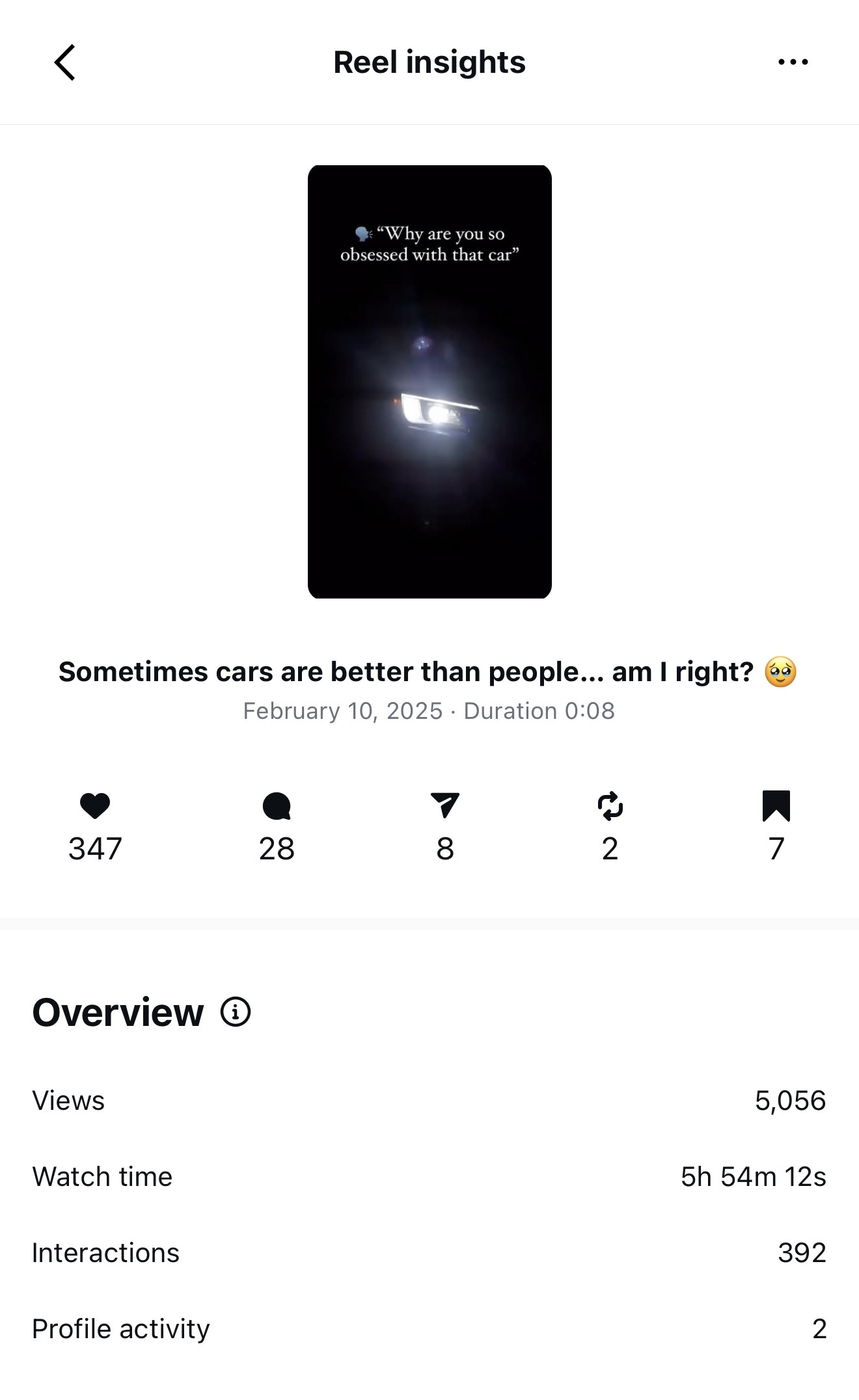
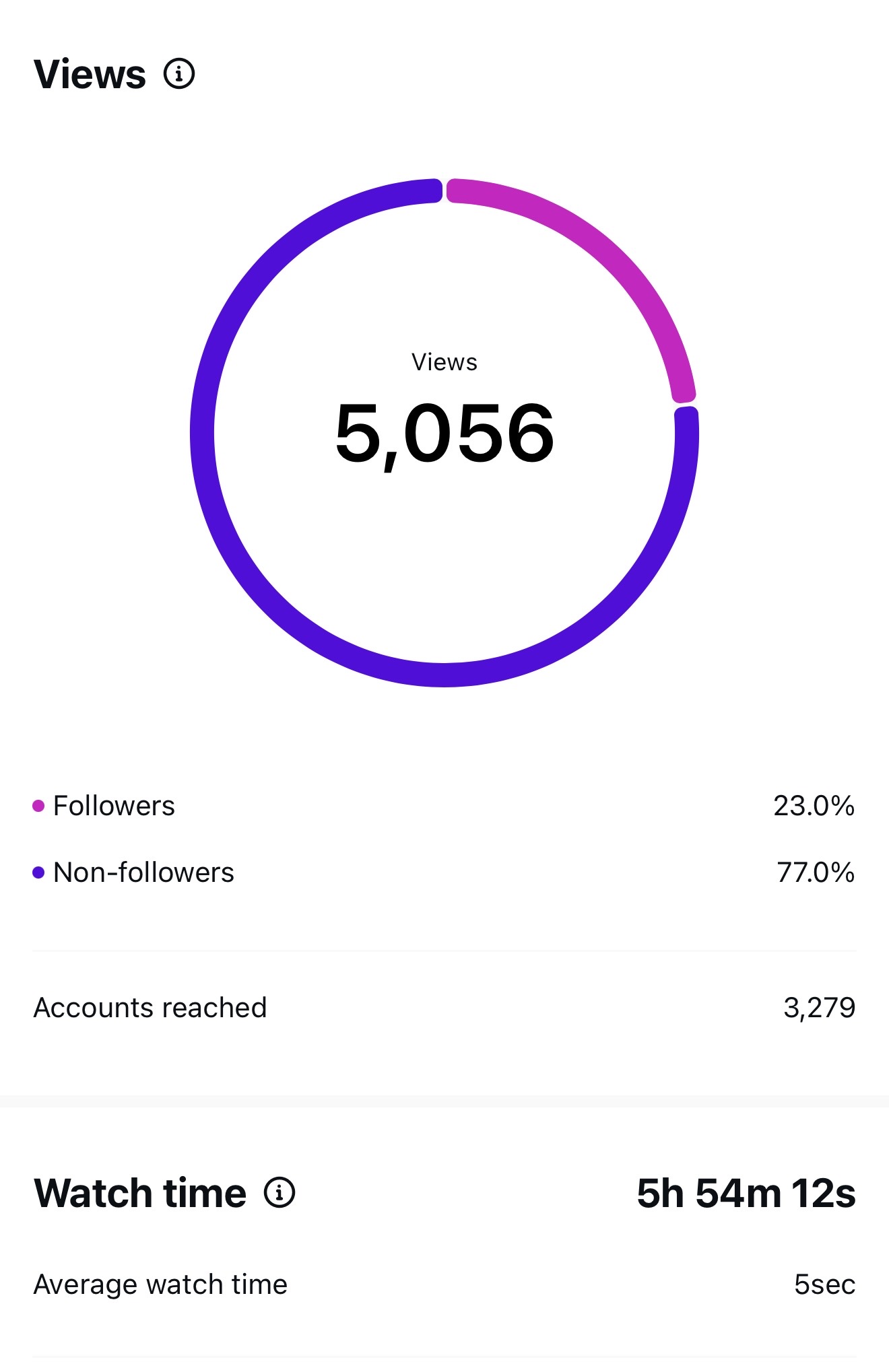
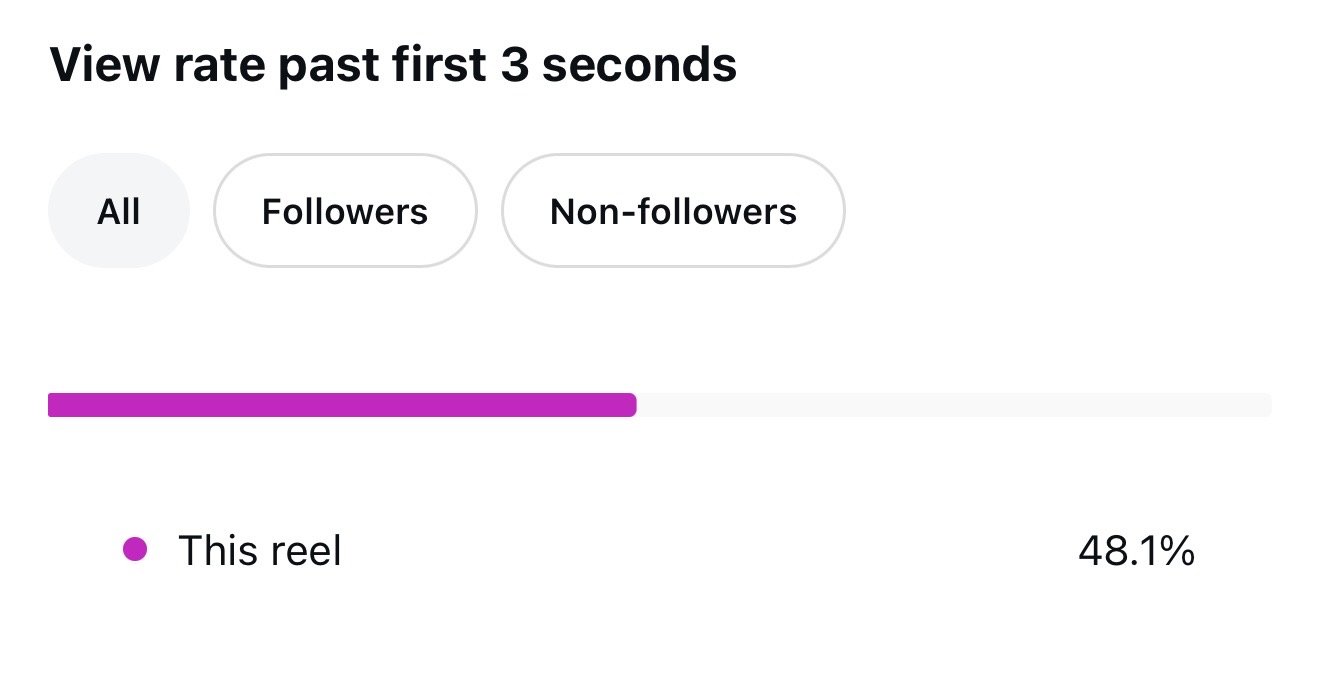
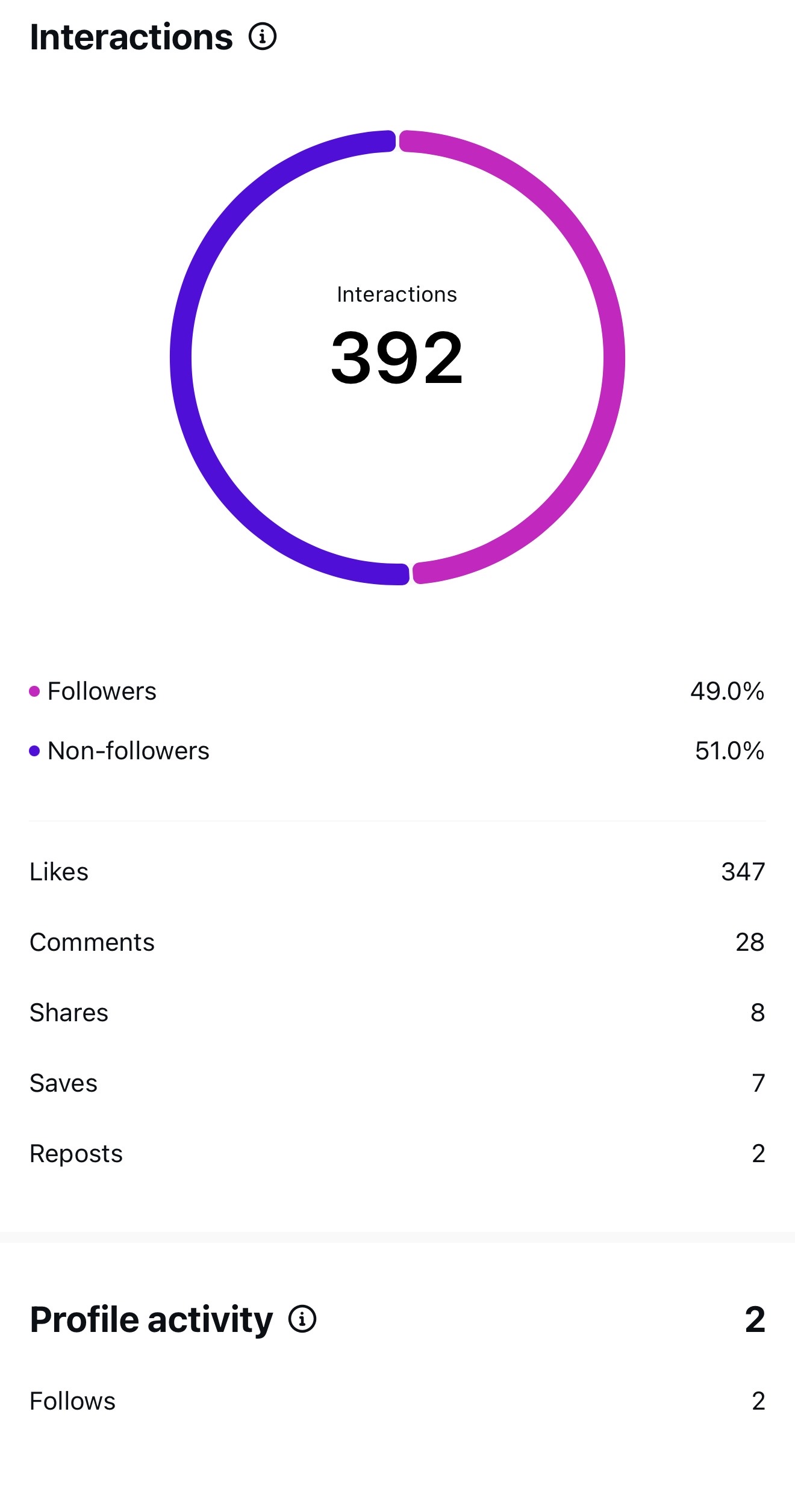
"Sometimes cars are better than people... am I right?"
February 10, 2025. 5,056 views. 77% non-followers.
When I posted something personal, non-followers connected with it more than my own audience did. The driven reel was watched by 66% non-followers, and they watched all 8 seconds. 41 people visited my profile. But none of them followed. People who'd never seen my account before resonated with it more than the people who'd been following me for years.
The disconnect wasn't content quality. It was audience composition. I'd spent years building a mixed-content account, lifestyle, cars, personal, everything, and when I pre-launched the brand, they didn't leave. They just stopped engaging. With everything. Not just the brand content, not just the personal content. Even the car-season collab that pulled 20K views, only 13% of the likers were my actual followers. The people who connected with the personal content were passing through, not staying. And the people who'd followed me for years had checked out entirely.
The Techniques That Worked (and Why)
Looking at what worked across the reels I tracked, a few patterns stood out.
Dense text overlay as a replay mechanic. The text-loop reel, my highest-viewed, packed multiple text segments into a 6-second video. You can't catch everything in one loop, so people stay through the next one. The algorithm reads that as high retention and pushes it wider. Average watch time was 5 seconds on a 6-second reel, an 83% completion rate.
Tension-and-payoff audio sync. The car-season collab opened with 4 seconds of slow buildup before a perfectly timed bass drop. The pacing shift mirrors the music energy. The visual palette shifts from dark and muted to bright and saturated at the exact moment of the drop. But the real hook was the content itself: every Canadian car enthusiast knows the countdown to car season. That shared experience, combined with the collab reach, is why 87% of the views came from non-followers. That reel had the best retention I recorded for a reel of that length.
Casual visual plus heavy text. The driven reel paired an everyday shot with emotionally heavy text and intense rock audio. The mismatch between what you see and what you read forces you to stop and process. But the technique only got people to pause. What made them stay was that the message itself was relatable. Technique gets attention. Substance keeps it. That reel had a 37% skip rate and 100% average completion.
Trending format with real data. One reel used a popular format where you show something unexpected, but instead of a punchline, I hard-cut to my Instagram Insights screenshots and then to the profile: 2.7K followers. The gap between the view counts and the follower count is the content. No explanation needed. Show the data, let the viewer draw the conclusion.
What I'd Do Differently
Define the audience before building the content. I spent over five years attracting followers without ever deciding who I was trying to reach. By the time I figured it out, the audience was already locked into their expectations. If I were starting a content account tomorrow, I'd decide on day one: who is this for, what do they need, and what will make them come back.
Keep different content on different accounts. Running personal content, car content, and brand content all from the same account meant no one knew what to expect. The people who followed for cars didn't engage with the personal stuff. The people who connected with the personal stuff didn't care about cars. And when the brand pre-launched, neither group came along. One account trying to be everything ends up being nothing to most of the people following it.
Track engagement from the start, not years in. I didn't start analyzing my audience until I needed something from them. By then, years of followers who never engaged had piled up and the real engagement was impossible to see without digging. If I'd been watching the numbers from month one, I would've caught the mismatch years earlier.
Optimize for the right followers, not more followers. An account with over 2.8K followers where the majority never engaged is worse than a 500-follower account where everyone shows up. I know that now.
What Came Next
The brand I was building during this process, Osaka Nights, a JDM automotive lifestyle brand, is where the work continues. Different audience. Different strategy. Built on everything this account taught me.
I didn't lose the account. I had the proof I came for. The data told me everything I needed to know, and I made a decision based on what it said instead of what I wished it said.
Tools and Methodology
Data Sources
All analytics cited in this case study come from Instagram Insights (screenshot-verified), the official Instagram data export (January 3, 2026), and a custom engagement tracking system built from Chrome DevTools captures and scraping tools.
| Reel | Views | Non-Follower Reach | Notable |
|---|---|---|---|
| Car-season collab (Jan 2026) | 20,260 | 87% | 85 shares, 18 follows, 52.8% skip rate, collab w/ 39.8K + 10.7K accounts, 13.4% of likers were followers |
| Text-loop reel (Jul 2024) | 22,046 | 86.8% | 5s avg watch on 6s reel (83% completion) |
| The driven reel (Feb 2026) | 3,477 | 65.6% | 37% skip rate, 100% avg completion, 41 profile visits, 0 follows |
| Cars better than people (Feb 2025) | 5,056 | 77% | 5s avg watch on 8s reel |
| 101-comment reel (Jun 2024) | 3,441 | N/A | 101 comments (highest on account), 256 likes |
| Comeback reel (Dec 2025) | 1,917 | 30.4% | 69.6% follower views, 0 follows, 60.8% skip rate, 84 likes, 26 comments |
Account data: Created August 23, 2020. Peak followers: approximately 2.9K (September 2025). At export: 2,782 followers, 71 live posts, 63 archived. Tracking system: 2,730 followers mapped across 20 posts with available liker data.
All numbers verified from primary sources. Nothing in this case study is presented that cannot be traced to an Instagram screenshot, official data export, or source data file.
Research That Informed This Analysis
- Ed Wood (CMO, CareerFoundry), portfolio evaluation criteria for marketing hires (YouTube interview)
- Pillemer, Harrison, Murphy, and Park, "Audience Entanglement" (Administrative Science Quarterly, 2025), creator-audience dependency dynamics
- Santos et al., content incongruity and audience response (Psychology & Marketing, 2023)
- Non-follower reach benchmarks for accounts under 10K followers (CreatorFlow, Qoruz, Sprout Social)
Account permanently deleted March 2026. Case study April 2026.